In shortXochimilco is a borough in the south of Mexico City, about 28 km from the centre, where the surviving canals of the old lake are crossed by painted flat-bottomed boats called trajineras. Around 184 km of water runs between the chinampas, farming plots built up by hand and still planted, inside a protected wetland of 26.57 km2 that UNESCO listed in 1987.
184 kmnavigable canals
28 kmsouth of the centre
26.57 km2protected wetland
1987UNESCO inscription
What is Xochimilco, and where exactly is it
Xochimilco is an alcaldía, or borough, on the southern edge of Mexico City, roughly 28 km from the centre. What you see from a boat is the remnant of the shallow lake that once covered this part of the valley: about 184 km of navigable channels, with chinampas, hand-built raised farming plots, squared off between them. Vegetables and flowers grown on those plots still reach the borough's kitchens.
Protection here works on two levels. The Xochimilco and San Gregorio Atlapulco lake system is a formally protected wetland of 26.57 km2, or 2,657 hectares, and conservation work inside it is built around the axolotl, the amphibian that has become the emblem of Mexico City. On 11 December 1987 the area was inscribed on the UNESCO World Heritage List as a cultural site under criterion (v), together with the historic centre of Mexico City, as property ID 412.
Distance is the part most visitors underestimate. Measured in time rather than kilometres, the trip out of Roma Norte comes to 75 to 90 minutes if you ride the metro and then the light rail, or 45 to 70 minutes in a car or ride-hail, with Sunday afternoons slower again. Two systems get you there: Line 2 of the metro as far as Taxqueña, then the Tren Ligero, whose 18 stops cover 13 km of single line before it finishes at Terminal Xochimilco. Those travel times are why organised days here start with a hotel pick-up or a central meeting point rather than a short hop across town.
The name covers three different places
Search results run the canals, the old town and the wider borough together, and they are three separate visits. Which of them you pick decides where you ask a driver to drop you and how much of the day you need.
- The canals and chinampas. Boats leave from authorised embarcaderos, the landing stages, and ten of them work 365 days a year. Nativitas, Zacapa and Las Flores Nativitas sit at the traditional end of the scale, with parking, craft markets and restaurants on land. Boats from Fernando Celada, Cuemanco and Puente de Urrutia work the protected natural zone instead, which is the water where migratory and endemic birds turn up.
- The historic centre. Seventeen original barrios around a central plaza. Its anchor is San Bernardino de Siena, church and former monastery, standing on Av. Guadalupe I. Ramírez since the work started in 1535; inside is a rare 16th-century Plateresque altarpiece whose only comparable survivor is at Huejotzingo in Puebla, and the complex has counted as a national monument since 1932. The Jardín Juárez next door fills the old atrium, 0.07 km from the Plaza Central.
- The borough as a whole. Fourteen villages that stood here long before the city reached this far lie inside the protected area. Away from the water there is the Parque Ecológico de Xochimilco, some 165 hectares at Periférico Oriente #1 protecting canals, chinampas and axolotl habitat; the Museo Dolores Olmedo at Av. México 5843 in La Noria, open Tuesday to Sunday 10:00 to 18:00 with last admission at 17:30; the Mercado de Xochimilco on Av. Nuevo León, daily 8:00 to 20:00 with roughly 450 vendors; and the Cuemanco plant and flower market, daily 8:00 to 16:00 with about 600 traders.
The canals and Frida Kahlo
If you came to this page to work out what Xochimilco is, one day covers it: 6-7 hours, from $56, 4.9 ★ (1352 reviews), with private transport and hotel pick-up, a trajinera ride, a walk through Coyoacán and Frida Kahlo Museum entrance when that option is selected.
★ 4.9/5 · 1,352 reviews
What a ride on the Xochimilco canals is actually like
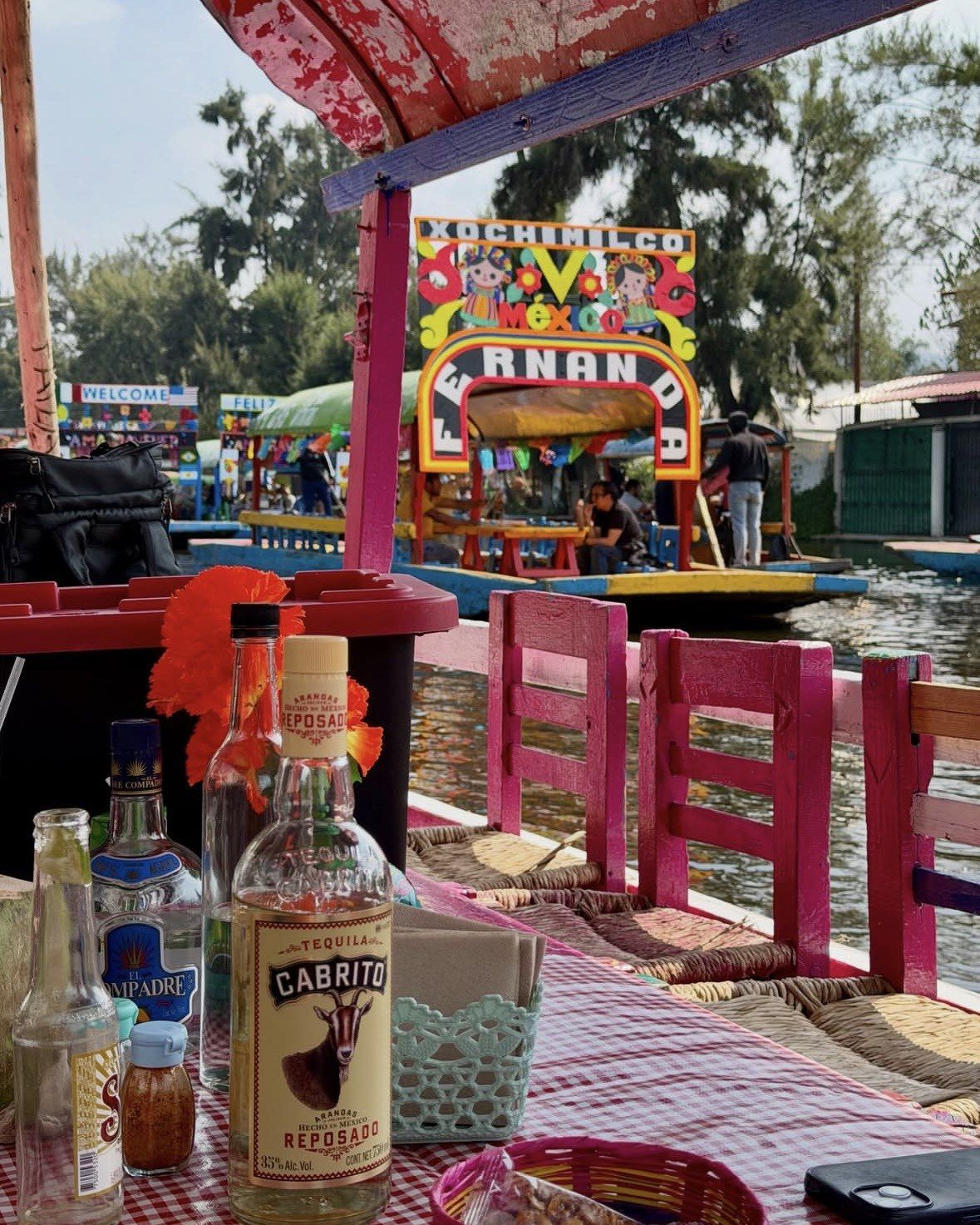
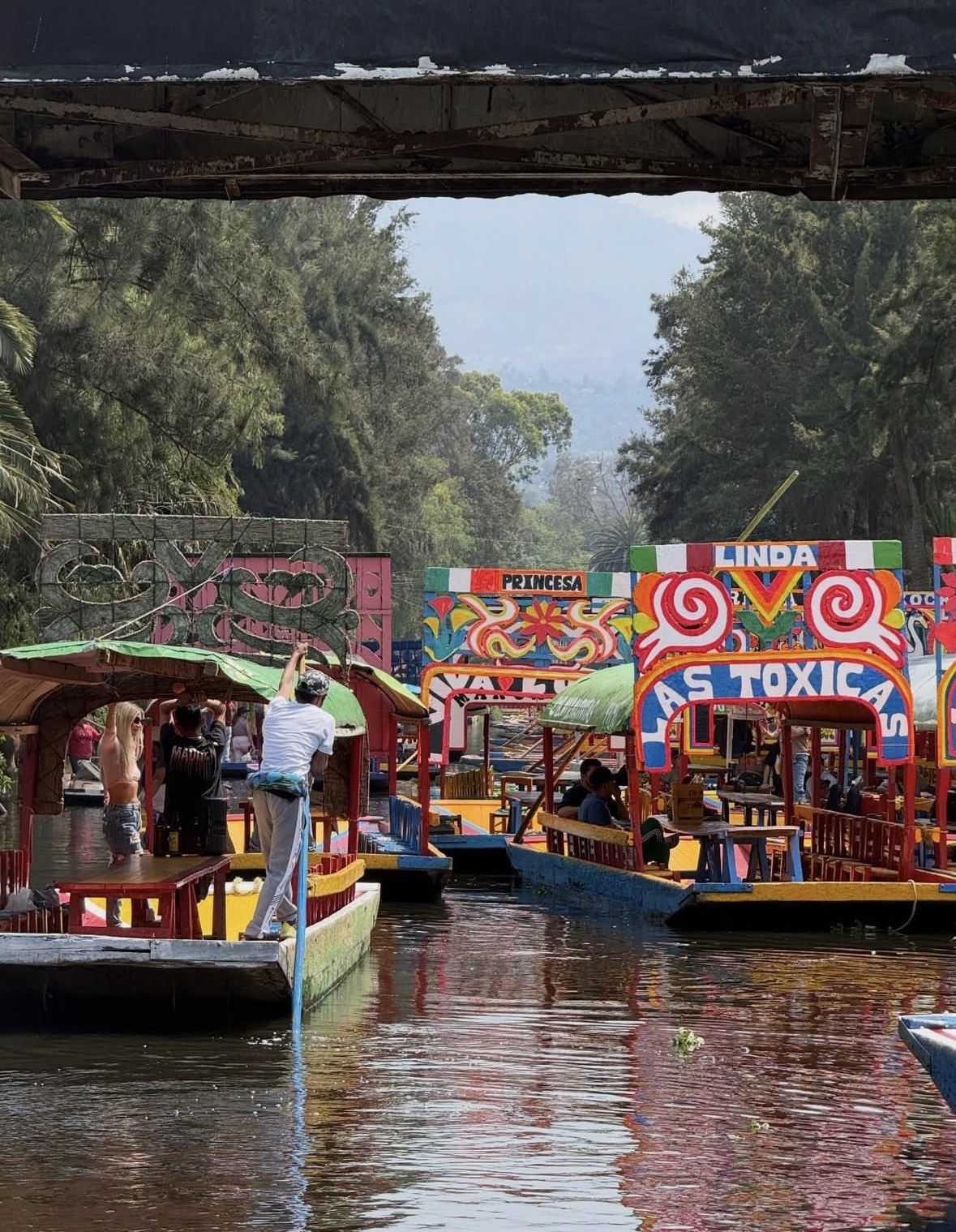
A trajinera is a wide wooden boat with a flat bottom, a roof, a long table with chairs down the middle and a painted arch at the bow carrying a woman's name. A boatman poles it along, so the pace is slow and voices carry across the water. The limit of 18 passengers per boat is applied strictly, and children under four count towards it.
Traffic on the canal is part of the day on the traditional routes. Smaller boats pull alongside: marimba and mariachi musicians who play by the song, cooks selling quesadillas, esquites and drinks, photographers, vendors with blankets and flowers. Only the sound systems supplied by the operators are allowed on board, so leave your own speaker at the hotel. What you may drink is fixed too: one bottle of spirits for the whole boat, or three beers for each adult aboard.
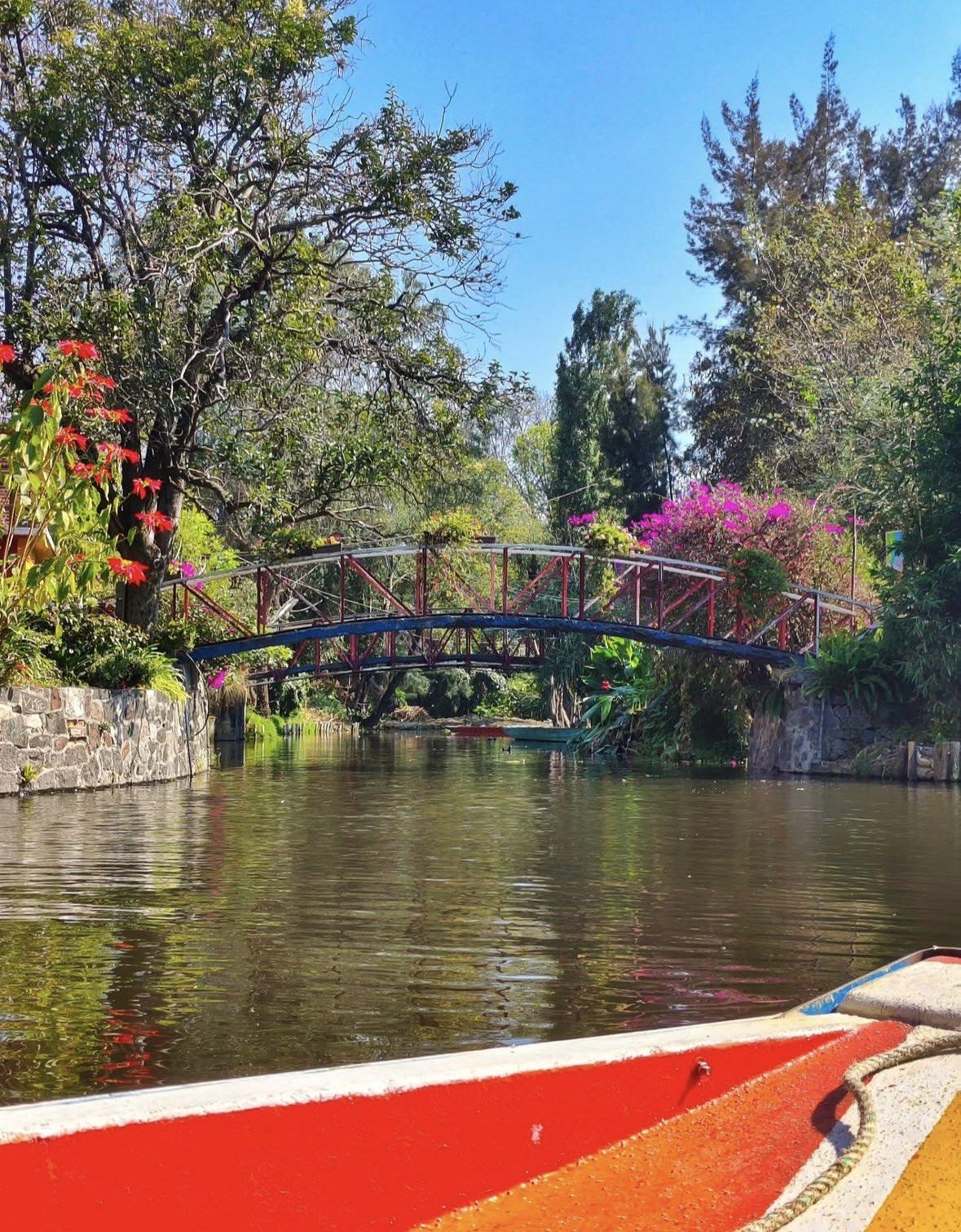
Either side of the channel the chinampas are in production: beds of flowers and vegetables, plastic greenhouses, willows holding the banks together. The villages in this belt, San Luis Tlaxialtemalco, San Gregorio Atlapulco, Santiago Tepalcatlalpan and Santiago Tulyehualco, grow most of Mexico City's marigolds, almost 10 million plants in 2026 from 596 producers, against just over a million in 2019.
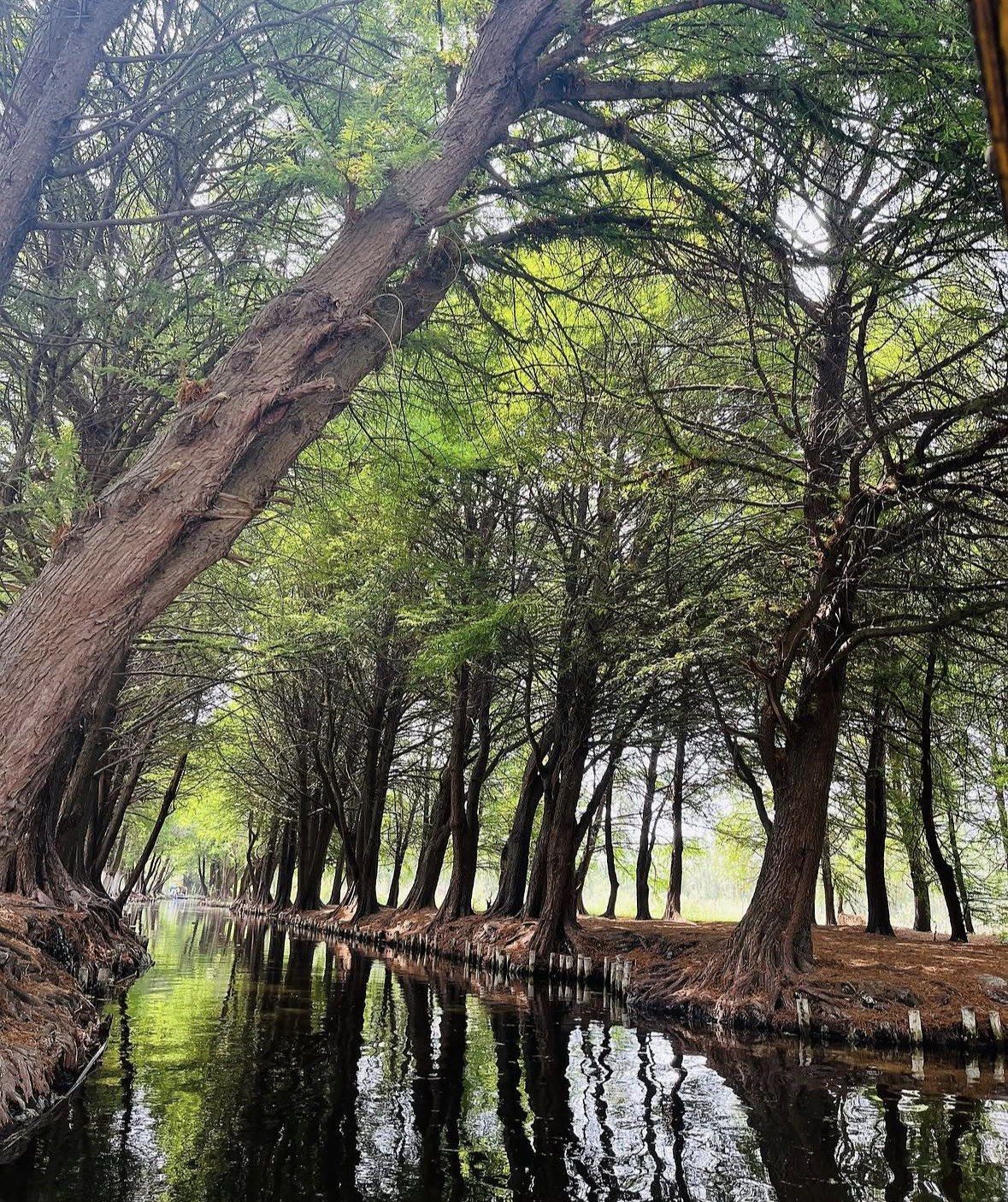
Ecological routes feel like a different outing. The vendor boats thin out and you get open water, herons and the chance of axolotl conservation sites along the bank. How crowded it feels depends on the dock more than on the season: about 220 boats work out of Nuevo Nativitas and around 215 from Caltongo, while Salitre, opened in 1921, has about 51. No lighting runs along the canals, so boats generally work between about 8:00 and 17:00 even where the docks stay open later. Go early.
Where the name comes from
The name is Nahuatl and is usually translated as the place of the flower fields, from the words for flower and cultivated plot. That matches the chinampas: plots raised by hand between roughly the 14th and 16th centuries, farmed in the water, and still planted today.
Flowers are still the local trade. The Cuemanco market across the road from the ecological park sells cacti, fruit trees, bonsai, tulips, violets and medicinal herbs from about 600 stalls, and the Madreselva market stands inside the Bosque de Nativitas, 0.28 km from Embarcadero Nuevo Nativitas. The festival calendar runs on the same crops: the Feria de la Flor Más Bella del Ejido ran 7 to 13 April according to the borough's bulletins, and the Feria de la Alegría y el Olivo has filled Plaza Quirino Mendoza in Santiago Tulyehualco every February since 1971.
Which tour style fits your day
On a first visit, treat the canals as half a day and give the other half to Coyoacán. Two tours on this site do that in different shapes: a small group of 6-7 hours with hotel pick-up, or a full 9-hour day leaving from a central meeting point. Both put you on a trajinera and both pair the water with Coyoacán and a Frida Kahlo house museum, the combination most itineraries from the centre are built around.
The Frida Kahlo Museum is the reason to let a tour handle the tickets. Nothing is sold at the door, admission is bought in advance for a calendar date and a 15-minute arrival slot between 11:00 and 17:00, and busy dates are flagged as low availability. Mondays are closed. Tuesday runs 10:00-18:00, Wednesday opens an hour later at 11:00 and still shuts at 18:00, Thursday starts at 10:00 and stays open to 21:00, and Friday through Sunday it is 10:00-18:00.
If you would rather read more before choosing, other pages on this site go further into the chinampas and how they are farmed, the trajineras and the rules that apply on board, and getting to the borough by light rail, bus or car.
| Tour | Duration | From | Rating | Transport | Best for |
|---|
| PREMIUM Frida Kahlo Museum and Xochimilco (Small Groups) | 6-7 hours | $56 | 4.9 ★ (1352 reviews) | Private transportation with hotel pick-up and drop-off; meets at the Angel of Independence, entrance of the Sheraton Hotel | A first visit that wants the canals and Frida Kahlo in one small group: a trajinera ride, a walk through Coyoacán, a music speaker on the trajinera, a Mexican churro, a certified guide and a mariachi song |
|---|
| Xochimilco, Coyoacan and Frida Kahlo with Optional Lunch | 9 hours | $40 | 4.6 ★ (8447 reviews) | Transport from central meeting points: behind the Palace of Fine Arts, 2 Avenue Hidalgo, at 08:20 a.m., or Miga Cafe, Liverpool 174, at 07:50 a.m. | The longest classic day at the lowest entry price: a ride in a colourful trajinera, a certified guide in English or Spanish, with museum tickets, Casa Kahlo and lunch as selectable options |
|---|
Questions people ask
Is Xochimilco part of Mexico City?
Yes. It is one of Mexico City's boroughs, about 28 km south of the centre, and you can reach it on city transport the whole way. On rails that means Line 2 of the metro to Taxqueña, then the Tren Ligero, 18 stations and 13 km of single line, as far as its Terminal Xochimilco stop. Buses cover it too: Ruta 36 from the Paradero Norte at Taxqueña, or Ruta 26 from Metro Pino Suárez, which stops about two blocks from the historic centre.
Why is Xochimilco a UNESCO World Heritage Site?
It was inscribed on 11 December 1987 as a cultural site under criterion (v), jointly with the historic centre of Mexico City, as property ID 412. The chinampa system is the reason: farming plots built up by hand between roughly the 14th and 16th centuries, still cultivated and still feeding the borough's cooking. The protected area also takes in fourteen original villages alongside the canals.
What is a trajinera?
It is the flat-bottomed wooden boat used on the canals: roofed, with a long table and chairs inside and a painted arch over the bow carrying a name. A boatman poles it along instead of using a motor. The limit is 18 passengers per boat, applied strictly, and children under four count towards it.
Is there anything to do in Xochimilco besides the boat ride?
Plenty, and most of it is on dry land. The historic centre gathers 17 barrios around the plaza and the 16th-century church of San Bernardino de Siena, whose restoration after the September 2017 earthquake finished in 2020. The Museo Dolores Olmedo in La Noria opens Tuesday to Sunday 10:00 to 18:00 with last admission at 17:30, and the Mercado de Xochimilco trades daily 8:00 to 20:00, where comida corrida is the thing to order.
What time of day and year do the canals work best?
The authorised embarcaderos operate every day of the year, so the season is rarely the deciding factor. The hours are the real constraint: with no lighting on the water, boats generally run between about 8:00 and 17:00. Nuevo Nativitas is listed open daily 6:00 to 22:00 and Fernando Celada Monday to Friday 8 a.m. to 6 p.m. and Saturday and Sunday 8 a.m. to 10 p.m.; check on the day, since not every dock publishes a timetable. From early June the borough issues rainy-season bulletins, so take a morning departure through the summer.
Read also