In shortWhat to eat in Xochimilco divides into three settings. On the canal, food boats pull alongside the trajinera with grilled corn, quesadillas, tacos and sweets. What you drink is rationed by rule: one bottle of spirits for the whole vessel, or three beers for each adult aboard. The larger landings have small restaurants, and the Mercado de Xochimilco, open daily 8:00 to 20:00, is the place for comida corrida.
8:00–20:00Mercado de Xochimilco, daily
450market traders, two buildings
3 beersper adult allowed aboard
3.5 hoursmarkets and canals food tour
Food boats in Xochimilco, and what comes alongside
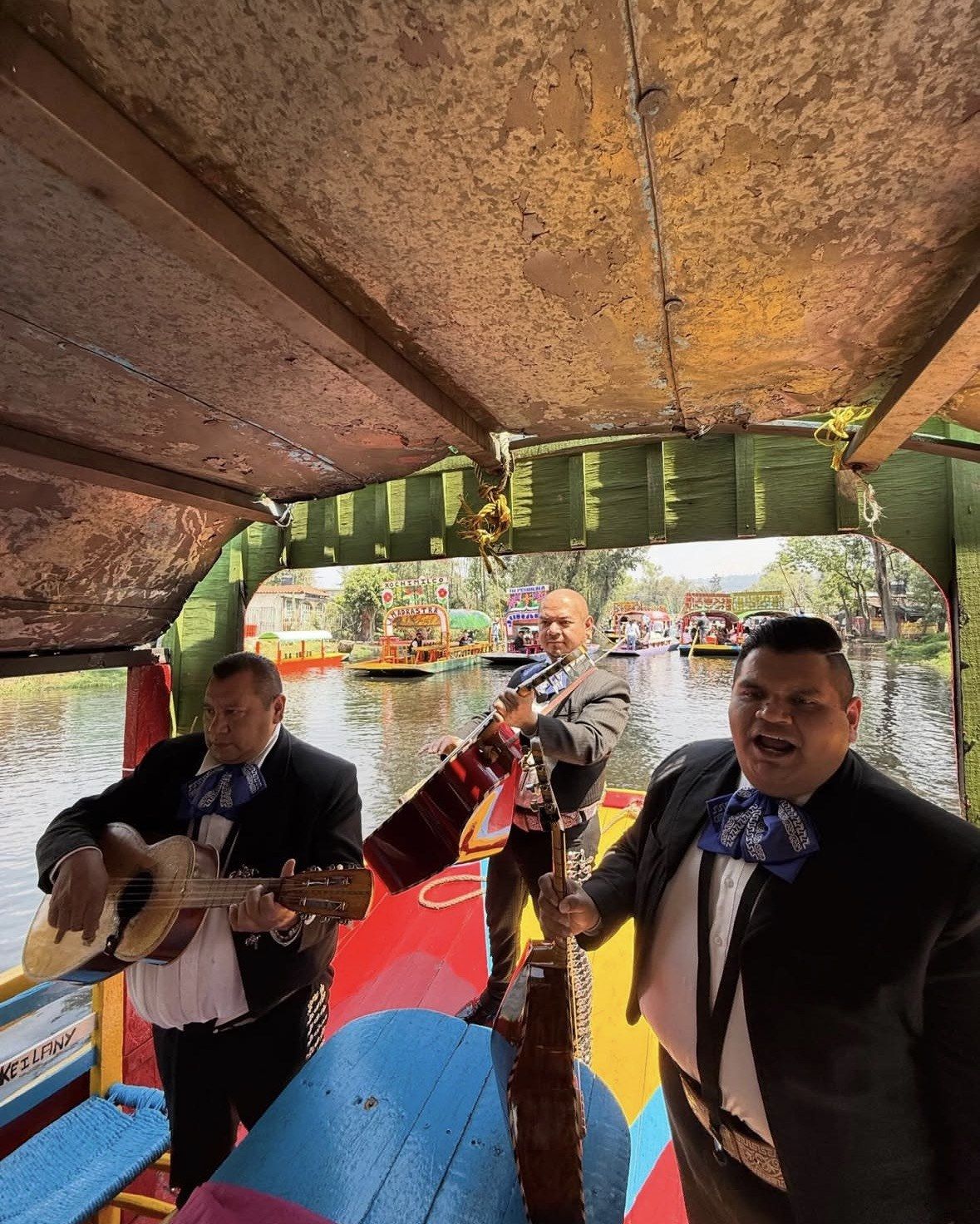
The canal carries working traffic as well as painted trajineras. Smaller boats loaded with a comal or a charcoal grill slip between the hulls and pull up beside you as you pass, selling grilled corn, quesadillas, tacos and, towards the end of a run, sweets. Music boats work the same stretch of water, and on a Sunday afternoon around the Nativitas embankment you will meet several of each over the course of a two-hour ride.
The handover happens boat to boat, and the canal rules decide how. Passengers stay seated with hands and feet inside the hull, nobody may move to another boat during the ride, and jumping or stepping across is forbidden. The boatman brings your trajinera alongside the vendor and does the manoeuvring.
Rubbish is the part people forget. Plates, cups, corn husks and bottles ride back with you until the operator shows where they go, and the water you have been eating over is a protected wetland of 2,657 hectares whose conservation work is built around the axolotl. Toilets are for authorised stops only.
Xochimilco drinks: what you can take on board
Alcohol aboard is capped at one bottle of spirits per boat or three beers per adult passenger, and the bottle limit applies to the whole vessel however many of you are on it. Drink past the obvious point and the operator reports you to the tourism desk. Bringing your own loud music equipment is prohibited, and only the public-address systems and speakers the operators provide are allowed, so leave the Bluetooth speaker at home.
The tours on this site handle drinks differently from each other. The 3.5-hour markets-and-canals tour includes coffee or tea with sweet bread or a tamal at the start, then hibiscus flower water along the boat trip. The 9-hour Coyoacán and Frida Kahlo day lists drinks as not included, with lunch at a local restaurant as a selectable option, so plan on buying your own.
Pulque belongs to the town more than the water. It turns up in the historic centre around the Day of the Dead programme, whose pulquería and offerings strand ran from 29 October to 2 November in 2026.
A full day with lunch as an option
If you would rather not fit the meal around the dock hours, this 9-hour day leaves from a central meeting point with a certified guide in English or Spanish and lists lunch at a local restaurant as a selectable option, from $40, 4.6 ★ (8447 reviews).
★ 4.6/5 · 8,447 reviews
Eating at the landings
Nativitas, Zacapa and Las Flores Nativitas are the most traditional of the landings, and they are the ones with facilities behind them: large premises, parking, craft markets and restaurants. Nuevo Nativitas is the largest and most developed of the ten authorised embarcaderos, opened in 1970, bases about 220 boats and is listed daily 6:00 to 22:00, with small restaurants and a crafts market on land.
Plan the eating around the light. Nothing illuminates the channels, so the boats themselves tend to work roughly 8:00 to 17:00 while Nuevo Nativitas, with its small restaurants, is listed open until 22:00. Ride first and eat afterwards: the restaurants behind the dock are still open when you tie up. Zacapa and Las Flores Nativitas publish no hours on the city portal, so check on the day.
The ecological launches work differently. Food boats are not the reason to pick Fernando Celada, Cuemanco or Puente de Urrutia: those three send their routes into the protected natural zone, where the migratory and endemic birds are what you came for, and Fernando Celada shuts at 6 p.m. Monday to Friday. Eat before you board, or plan the meal on land.
| Place | Where | Hours | What is there |
|---|
| Embarcadero Nuevo Nativitas | Carretera Nativas Tulyehualco-Xochimilco s/n, Santa María Nativas, 16450 | Daily 6:00–22:00 | Small restaurants on land, large crafts market, parking, about 220 boats |
|---|
| Nativitas, Zacapa and Las Flores Nativitas | The Nativitas embankment | Not published for Zacapa and Las Flores; check on the day | The most traditional landings, with large facilities, craft markets and restaurants |
|---|
| Mercado de Xochimilco | Av. Nuevo León s/n, Santa Crucita, 16070 | Daily 8:00–20:00 | Roughly 450 traders across two buildings; comida corrida |
|---|
| Mercado de Plantas y Flores de Cuemanco | Canal Nacional 2000, Coapa, Cuemanco, 16036 | Daily 8:00–16:00 | About 600 traders, across the road from the ecological park |
|---|
| Madreselva market | Inside the Bosque de Nativitas, 0.28 km from Nuevo Nativitas | Not published | Plants and flowers, the closest market to the main landings |
|---|
The market, the fondas and the February fair
Two buildings on Av. Nuevo León hold roughly 450 traders between them, open every day from 8:00 to 20:00. The city calls the market the regional distribution centre for the borough's farming area and points visitors towards comida corrida, the set-price midday meal served in the fondas inside. Tamales in the morning, barbacoa at the weekend and a pot of mole on the counter all sit within a few metres of one another.
The produce is local in a way that is unusual for a city this size. The chinampas were built by hand between roughly the 14th and 16th centuries, they are still planted, and the borough states that its cuisine still uses what grows on them.
Amaranth sweets and olive products have a fair of their own. It is called the Feria de la Alegría y el Olivo, and it has filled Plaza Quirino Mendoza in Santiago Tulyehualco each February since 1971. If you are here in February, the fair is worth a stop of its own; the amaranth stalls are the reason to go.
- Comida corrida in the market fondas, daily 8:00 to 20:00
- Tamales, barbacoa and mole, cooked with chinampa produce
- Pulque in the historic centre, strongest around the Day of the Dead programme
- Amaranth sweets and olive products at the February fair in Santiago Tulyehualco
Chinampa-to-table near the ecological dock
Beside the Cuemanco dock, several working chinampas serve meals out on the plot, built around produce cut that morning. The format is much the same at each: a guided trajinera ride out through the channels, a walk over the farmland, then the meal, with the whole thing running at least three hours. Public dates fall on weekends and long weekends, and private groups need advance notice.
Advance reservation is the only way in. Decide on this first and let the rest of the day fit around it. If your plans are still loose, the protected-zone routes from Cuemanco and Fernando Celada show the farmland and the birds from the water instead.
A shorter way onto the farmland is the markets-and-canals food tour on this site, which fits a traditional chinampa and an axolotl sanctuary into 3.5 hours, bicitaxi leg included.
An all-inclusive boat day, or a market and chinampa food tour
Take the food tour if eating is the reason you are coming south. Guacamole a Tasty Adventure Through Xochimilco Markets and Canals lasts 3.5 hours, from 1,900 pesos, 5.0 ★ (12 reviews), and the food starts before the water does: coffee or tea with sweet bread or a tamal, then all the ingredients to prepare a taco placero and hibiscus flower water once you are aboard, with a traditional chinampa and axolotl sanctuary on the route and a bicitaxi ride carrying you from the markets to the pier. You meet at Patio ciento 20, a small local restaurant set back from the street between Vicente Guerrero and Francisco I. Madero.
A full day suits you better if the canal is one stop in a wider itinerary and you would rather have the meal arranged. Xochimilco, Coyoacan and Frida Kahlo with Optional Lunch runs 9 hours, from $40, 4.6 ★ (8447 reviews), with transport from central meeting points, a ride in a colourful trajinera, a professional certified guide in English or Spanish, a digital Frida Kahlo guide in English and Spanish, and lunch at a local restaurant as a selectable option; drinks and tips are not included. You join it in the centre, either behind the Palace of Fine Arts at 2 Avenue Hidalgo for 08:20 a.m. or at Miga Cafe, Liverpool 174, for 07:50 a.m.
With a smaller group, the eating stays light on PREMIUM Frida Kahlo Museum and Xochimilco (Small Groups): a Mexican churro is the food on the list, alongside private transportation, hotel pick-up and drop-off, a walk through Coyoacán, a trajinera ride, a music speaker on the trajinera, a mariachi song and a certified tour guide, over 6–7 hours, from $56, 4.9 ★ (1352 reviews). The start is the Angel of Independence, by the Sheraton Hotel entrance.
- Food is the point: markets and canals food tour, 3.5 hours, from 1,900 pesos, 5.0 ★ (12 reviews)
- Canal plus Coyoacán with lunch as an option: 9 hours, from $40, 4.6 ★ (8447 reviews)
- Small group, churro and mariachi on the water: 6–7 hours, from $56, 4.9 ★ (1352 reviews)
Questions people ask
What is comida corrida and where do I find it in Xochimilco?
It is the set-price midday meal served in the fondas: usually a soup, a rice or pasta course and a main. The city recommends the Mercado de Xochimilco for it, on Av. Nuevo León s/n in Santa Crucita, open every day from 8:00 to 20:00. The market also acts as the distribution centre for the borough's farming area, so what is cooked there starts close by.
Can I bring my own food and drink on the trajinera?
The published canal rules set the alcohol ceiling at one bottle of spirits per boat or three beers per adult passenger, and they prohibit your own sound equipment. Rubbish stays on the boat until the operator shows you where it goes, and toilets may only be used at authorised stops. Count your group before you commit: the 18-passenger limit is strict and children under four are included in it.
Is there anywhere to eat after the boats stop for the day?
Yes. Boats generally come off the water around 17:00 because the channels have no lighting, but the landings stay open later, and Nuevo Nativitas is listed daily 6:00 to 22:00 with small restaurants and a crafts market on land. A late comida corrida is still realistic, since the market traders keep going to 20:00, and the fondas of the historic centre are a short walk from the Plaza Central.
Do the quiet ecological routes have food boats too?
Expect birds rather than vendors. Fernando Celada, Cuemanco and Puente de Urrutia send their routes into the protected natural zone, and what people come for there is the migratory and endemic birdlife rather than traffic alongside the hull. Eat before you board or afterwards, and bear in mind that Fernando Celada closes at 6 p.m. Monday to Friday. For a meal on the farmland itself, the chinampa experiences near Cuemanco take reservations in advance only.
Which single day gives me the most food in Xochimilco?
The 3.5-hour markets-and-canals tour, from 1,900 pesos, 5.0 ★ (12 reviews). Breakfast comes first, coffee or tea with sweet bread or a tamal; on the boat you are handed the ingredients for a taco placero and hibiscus flower water to drink, and the route calls at a traditional chinampa and an axolotl sanctuary. The bicitaxi leg from the markets to the pier is part of it.
Read also